 ENGLISH
 TÜRKÇE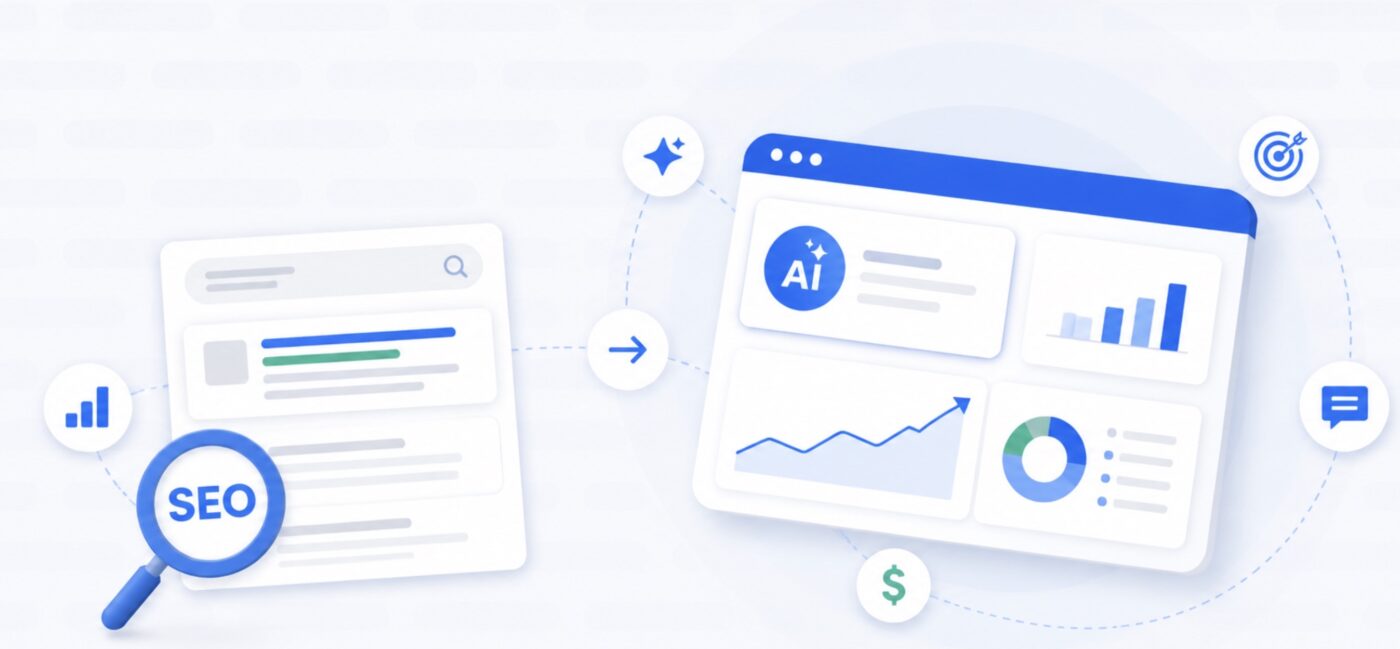
From SEO to AI Visibility: A New Growth Channel for High-Spend Advertisers
For years, visibility in digital marketing meant ranking on search engines. If your brand appeared on the first page of Google, you were part of the buyer’s discovery journey. If you ranked well for the right keywords, you could influence consideration, capture demand, and bring potential customers into your funnel. That logic still matters, and SEO is not going away. But discovery is no longer limited to search results pages.
Today, more decisions are beginning inside AI-generated answers. People are asking ChatGPT, Gemini, Claude, Perplexity, and other AI tools to explain problems, compare solutions, recommend providers, and summarize what matters. Instead of scanning ten links and forming an opinion manually, they often receive one structured answer that shapes what they believe, which brands they consider, and what they do next.
For high-spend advertisers, this shift matters because their decisions are rarely simple. When a brand spends six or seven figures on paid media, every operational choice carries weight. These teams need to decide which platforms to scale, which partners to trust, how to manage payment continuity, how to avoid account-level disruptions, how to reduce operational friction, and how to choose between automation tools, agencies, and infrastructure partners. These are not casual searches. They are high-intent questions, and increasingly, they may be answered before a user ever visits a website.
Search is moving from links to answers
Traditional search created a list of options. A user searched for something, clicked through different websites, compared information, checked reviews, and formed an opinion across multiple touchpoints. This gave brands several chances to influence the journey through rankings, landing pages, blog content, ads, retargeting, and sales follow-up.
AI search changes that journey. Instead of only showing where information exists, AI tools summarize what they believe the answer is. They can recommend brands, explain categories, compare providers, and decide which sources seem trustworthy enough to shape the response. This creates a new layer of visibility where the question is no longer only whether your website ranks, but whether your brand appears inside the answer itself.
For advertisers, this is not a small change. It affects how brands are discovered, how partners are evaluated, and how trust is built before a sales conversation begins. If an AI tool explains a category without mentioning your brand, the buyer may never know you should have been part of the comparison. If it mentions your brand but describes it incorrectly, the opportunity may still be weakened before the user reaches your site.
Why AI visibility matters for high-spend advertisers
High-spend advertisers operate in a more complex environment than smaller advertisers. They are not only choosing a campaign structure, creative format, or bidding strategy. They are managing larger budgets, multiple markets, platform risk, payment flows, account stability, reporting needs, operational speed, and performance expectations across channels. Because the stakes are higher, the research process is also more careful.
When these advertisers search for solutions, they often ask practical and commercially meaningful questions. They want to know how to scale Meta ads across multiple markets, how to avoid payment issues when ad spend increases, how to manage multiple ad accounts, which tools help ecommerce brands automate paid media decisions, what agencies can use to launch campaigns faster, and which partners support high-volume advertising operations. These are exactly the kinds of questions AI tools are designed to answer.
If an AI answer includes your brand as a relevant option, you enter the consideration set early. If it explains your positioning clearly, you gain credibility before the first touchpoint. If it recommends a competitor instead, you may lose the opportunity before the buyer reaches your website. That is why AI visibility is becoming a new growth channel. It does not replace SEO, paid media, or direct sales, but it influences the layer before the click.
AI visibility is not just brand mentions
Many teams will start by asking a simple question: does ChatGPT mention our brand? That is a useful starting point, but it is not enough. AI visibility is not only about whether a company name appears in an answer. It is about how the brand is understood, where it appears, which categories it is connected to, and whether it is recommended when the user is close to a decision.
There are several layers to measure. First, there is presence: does the brand appear at all when users ask relevant questions? Then comes accuracy: is the brand described correctly, or is it placed in the wrong category? Positioning is another layer: does the answer explain what the brand is actually built for? Recommendation strength also matters because a brand that is briefly mentioned is not in the same position as a brand that is actively recommended. Competitive context is equally important because visibility means more when you know which competitors appear more often and why.
A brand can be visible but misunderstood. It can be mentioned but not recommended. It can be known by the model but positioned behind competitors. It can appear in one market or use case and disappear in another. That is why AI visibility should be treated as a strategic diagnostic, not a vanity check.
From SEO keywords to AI answer contexts
SEO has traditionally focused on keywords, rankings, backlinks, technical health, and content relevance. AI visibility still depends on many of those foundations, but the focus expands. Instead of optimizing only for individual keywords, brands need to understand the full context of the questions buyers ask.
A high-spend advertiser may not search only for “Meta ad account provider.” They may ask how to scale Meta ads globally without payment issues, what to look for in an advertising infrastructure partner, how ecommerce brands can keep campaigns running when payment methods fail, or what the best way is for agencies to manage high ad spend across client accounts. These questions are broader, more conversational, and closer to real decision-making.
AI tools are built to respond to this kind of language. That means brands need content that answers not only what they offer, but also why the problem matters, how the category works, what buyers should compare, and what makes one solution more reliable than another. In other words, content strategy has to move from keyword coverage to decision coverage.
The new organic growth opportunity
For high-spend advertisers, AI visibility can become a powerful organic growth opportunity because it appears close to the moment of intent. A buyer asking an AI tool for recommendations is often not looking for entertainment. They are trying to reduce uncertainty, create a shortlist, understand risks, compare options, and avoid choosing the wrong partner.
If your brand is part of that answer, the conversation starts before the demo call, before the contact form, and before the retargeting campaign. This is especially important in categories where trust matters. Advertising infrastructure, account access, payment continuity, automation, and campaign operations are not low-stakes decisions. A wrong setup can slow down growth, interrupt campaigns, waste budget, or create avoidable operational pressure.
For buyers in these categories, AI answers can shape the first layer of trust. They can influence which brands are seen as credible, which options are ignored, and which problems feel urgent enough to solve. That makes AI visibility more than a brand awareness topic. It becomes a way to influence demand before the buyer enters a traditional funnel.
What brands should do now
AI visibility is still an emerging field. The rules are not as mature as traditional SEO, and no single checklist can guarantee that a brand will appear in every answer. Still, advertisers and growth teams can take practical steps now to understand where they stand and improve how they are represented.
1. Audit how AI tools describe your brand
The first step is to create a baseline. Start by asking major AI tools what your brand does, who it is for, and where it fits in the market. Then ask category-level questions where your brand should appear. This helps you understand whether AI systems recognize your company, whether they describe it accurately, and whether they connect it to the right buying contexts.
For example, a brand can test questions such as “What does this company do?”, “Who is it for?”, “What are the best partners for scaling paid ads globally?”, “What are the best solutions for managing high ad spend across Meta and TikTok?”, or “How can agencies reduce manual work in ad operations?” The goal is not to run a one-time experiment, but to track whether the brand appears consistently across relevant prompts, platforms, and markets.
When reviewing the answers, teams should look beyond simple mentions. They should record how the brand is described, which competitors are mentioned, whether there are citations or sources, whether the information is outdated, and what actions could improve the answer over time.
2. Make your positioning clear and consistent
AI tools rely on publicly available information, patterns, and context. If your website, blog posts, social channels, third-party mentions, and product pages describe your company in different ways, AI systems may struggle to understand where you fit. This is why clear positioning matters.
Your brand should be easy to classify. Your core audience should be obvious. Your value proposition should be repeated consistently across important pages. For high-spend advertisers, this means avoiding vague descriptions and clearly explaining who you serve, which platforms you support, what problems you solve, what makes your approach different, and what outcomes your solution is designed to support.
The goal is not to overstuff content with repeated phrases. The goal is to make your brand easy to understand, easy to compare, and hard to misrepresent. A clear and consistent message helps both human buyers and AI systems understand what your company should be associated with.
3. Build content around buyer questions, not only product pages
AI tools are useful because they answer questions. For that reason, your content should answer the questions your buyers actually ask, not only describe your product features. This includes educational content, comparison content, FAQ pages, category explainers, tactical guides, and problem-focused articles.
For example, instead of publishing only a page about an automation feature, a brand can also explain how ad automation helps ecommerce teams reduce wasted spend, why out-of-stock products create hidden performance issues, how agencies can use bulk ad creation to reduce operational workload, what high-spend advertisers should know about payment continuity, and how paid media teams can scale without adding unnecessary manual work.
This kind of content helps both humans and AI systems understand your relevance in real-world buying contexts. It gives AI tools more accurate material to work with and gives buyers better reasons to trust your perspective.
4. Strengthen the sources that shape AI answers
AI answers are influenced by the sources models can access, interpret, and trust. That means your own website matters, but it is not the whole picture. Third-party mentions, partner pages, review platforms, industry articles, case studies, interviews, directories, and credible external references can all shape how a brand is understood.
For high-spend advertisers, authority matters because buyers are looking for reliability. They do not want a clever claim. They want proof that the brand can support real budgets, real operations, and real growth pressure. A strong AI visibility strategy should therefore include both owned content and external credibility signals.
This does not mean chasing low-quality backlinks or publishing generic guest posts everywhere. The focus should be on credible, relevant, and consistent references that reinforce the same positioning. If the market repeatedly describes your company in a clear and accurate way, AI systems have stronger signals to learn from.
5. Make your website readable for machines and humans
AI visibility is not only a messaging issue. It is also a technical and structural issue. If important information is hidden inside images, blocked by scripts, missing from indexable pages, or written in unclear language, AI systems may not interpret it properly.
Brands should review whether their key pages are easy to crawl, read, and understand. Useful improvements include clear page titles and headings, direct explanations of services, strong FAQ sections, structured content, internal links between related topics, accessible HTML text instead of image-only messaging, up-to-date about and service pages, and schema markup where relevant.
These improvements are not only useful for AI systems. They also improve the experience for real buyers. A website that clearly explains what the company does, who it helps, and why it matters will perform better across search, AI discovery, and human evaluation.
6. Track competitors in AI answers
AI visibility is competitive. Your brand may not appear in an answer, but your competitors might. Or your brand may appear, but below another company that has stronger content, clearer positioning, or more external references. This is where AI visibility becomes useful as a market intelligence tool.
By testing relevant prompts regularly, brands can see which competitors appear most often, which use cases they dominate, which sources support their visibility, which claims or categories they are associated with, and where your brand is missing from the conversation. These insights can reveal content gaps, positioning gaps, and authority gaps that traditional SEO reporting may not show.
For high-spend advertisers, this competitive layer is especially useful because the market is often shaped by trust and perceived reliability. If AI tools consistently associate a competitor with a specific use case, that is a signal worth investigating. The next step is to understand why that association exists and what your brand needs to build, clarify, or publish to compete more effectively.
SEO is not dead. Discovery is expanding.
It would be easy to frame this shift as “SEO is dead.” That would be the wrong lesson. SEO still matters. Search engines still drive demand. Ranking pages still influence discovery. Technical optimization, useful content, and authority still play important roles.
But the discovery journey is expanding. A buyer might see a LinkedIn post, ask ChatGPT for context, check Perplexity for sources, search Google for alternatives, compare websites, and then speak to a sales team. The brands that win will not be the ones that treat each channel separately. They will be the ones that build a consistent presence across search, AI answers, content, community, and direct trust signals.
AI visibility is not a replacement for SEO. It is the next layer of organic growth. It adds a new question to every marketing strategy: when AI systems summarize the market, explain the category, or recommend options, does your brand have a place in that answer?
What this means for advertisers
For high-spend advertisers, the stakes are higher because the buying journey is more complex. The more money a brand spends, the more careful it becomes about infrastructure, continuity, and operational risk. The more markets it enters, the more it needs reliable systems. The more campaigns it runs, the more it needs clarity, speed, and control.
As AI tools become part of how teams research solutions, advertisers need to ask a new set of questions. Are we visible when buyers ask about the problems we solve? Are we described accurately? Are we recommended in the right category? Are competitors shaping the answer before we enter the conversation? Do our website, content, and external mentions give AI systems enough trusted information to understand us?
These questions will become more important as AI search behavior grows. The companies that start answering them now will have more time to shape how they are understood, where they appear, and what buyers associate them with.
The next growth channel starts before the click
The future of discovery will not belong only to brands that rank. It will belong to brands that are understood. For high-spend advertisers, AI visibility is an opportunity to show up earlier in the decision journey, clarify positioning, build trust, and influence how buyers evaluate solutions.
The work starts with a simple shift: do not only ask where your website ranks. Ask what AI says when your next customer is looking for a partner.
SHARE