 ENGLISH
 TÜRKÇE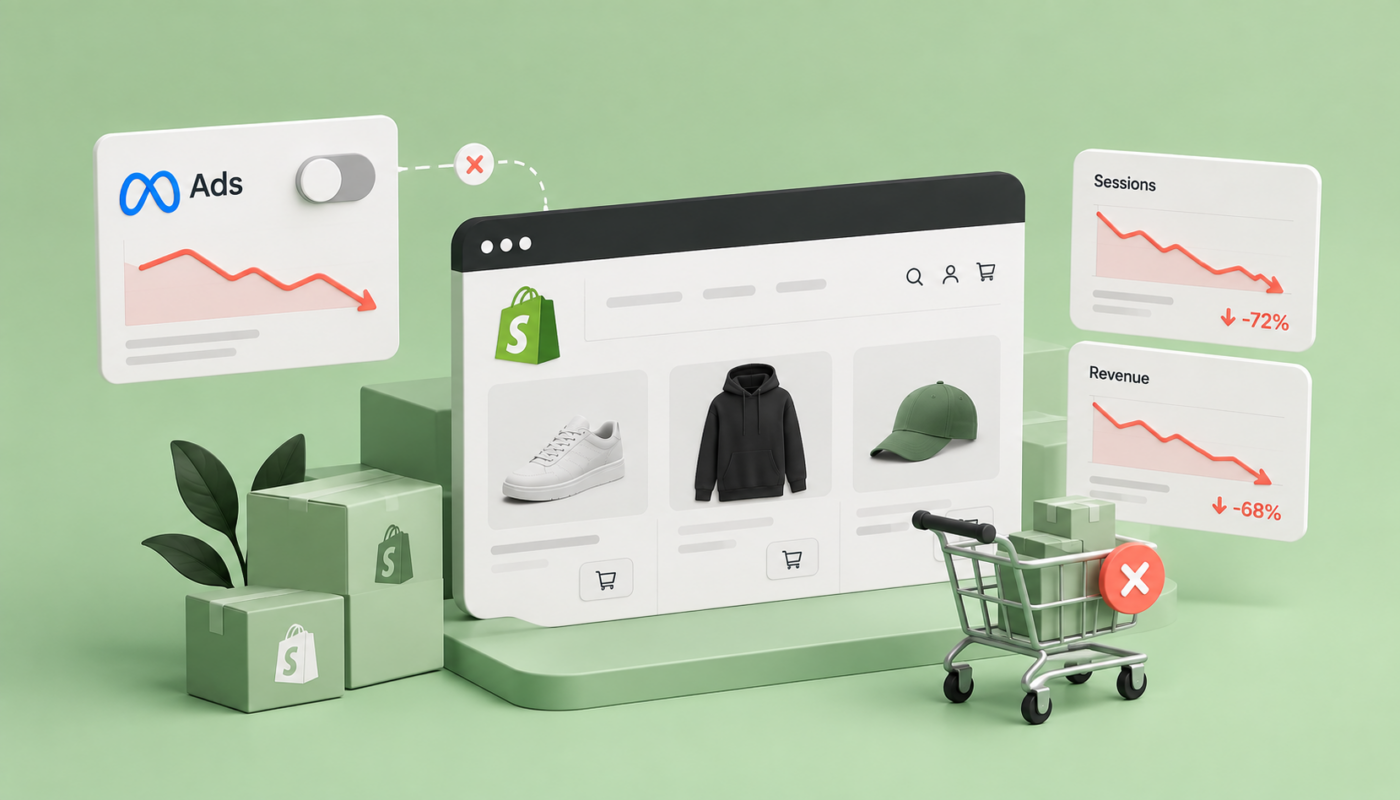
What Happens to a Shopify Plus Store When Paid Traffic Suddenly Stops?
For a high-volume ecommerce business, paid advertising is more than a line in the marketing budget. It is one of the systems continuously bringing customers into the store. Campaigns generate sessions, sessions create opportunities to convert, and those conversions feed the revenue forecasts that influence decisions across marketing, inventory, finance, and growth.
Shopify itself connects marketing activity with metrics including sessions, orders, conversion rate, sales, customer acquisition cost, and return on ad spend. For a Shopify Plus store with significant paid acquisition, that connection means an advertising disruption can quickly become more than a media buying problem.
The important question is not simply what happens to ad spend when campaigns stop delivering. It is what happens to the business activity that advertising was expected to generate.
Paid Advertising Is Part of the Revenue Operation
It is easy to think about advertising and ecommerce as two separate systems. One brings traffic in, while the other converts that traffic into purchases. Operationally, however, the two are closely connected.
Shopify’s marketing reporting reflects this relationship. Merchants can evaluate individual marketing channels using sessions, orders, sales, conversion rate, average order value, CPA, ROAS, and new versus returning customers. Shopify also distinguishes between paid and organic marketing activity and attributes sessions and sales to marketing channels.
That does not mean every Shopify Plus store depends on paid advertising to the same degree. A brand with strong organic search, direct traffic, email, affiliates, retail, or an established customer base may have a much more diversified acquisition mix.
But when paid acquisition represents a meaningful share of store traffic, advertising continuity becomes closely connected to revenue continuity.
A simple way to think about the relationship is:
Paid Advertising → Store Sessions → Conversion Opportunities → Orders → Revenue
An interruption at the beginning of that chain can therefore create effects much further down it.
What Actually Happens When Paid Traffic Stops?
Imagine a Shopify Plus brand spending heavily across paid social and search. The campaigns are performing, inventory has been planned around expected demand, and the growth team is working toward a monthly revenue target.
Then a meaningful part of its advertising stops delivering.
The first effect is straightforward: those campaigns are no longer generating the traffic they previously contributed. Google, for example, states that when a campaign is paused, its ads stop showing. Campaign delivery can also be affected by budget constraints, billing issues, eligibility, policy issues, or other account and campaign conditions.
But the commercial impact depends on what that traffic represented.
If paid advertising was responsible for a significant portion of acquisition, fewer paid sessions can mean fewer opportunities for purchases. That can affect daily order volume and marketing-attributed sales. The exact revenue effect will vary by brand, channel mix, conversion rate, customer behavior, and the duration of the disruption.
This is why the better question is not:
“How much ad spend did we miss?”
It is:
“What business activity was expected to come from that advertising?”
The Cost Can Be Bigger Than the Missed Ad Spend
Suppose a brand normally spends $20,000 per day on advertising.
If advertising is interrupted for a day, it would be misleading to say the business simply “lost $20,000.” That amount was an expense the business did not incur.
The more meaningful calculation starts with the revenue and customer acquisition activity that the spend was expected to support.
If the affected campaigns historically produced a certain number of sessions, orders, new customers, and attributed sales, the business can estimate its revenue exposure during the interruption. Shopify provides many of these metrics at marketing-channel level, including sales, sessions, orders, conversion rate, CPA and ROAS.
This distinction matters.
Missed ad spend is not the same as missed revenue.
And missed revenue is not automatically equal to permanent revenue loss either. Some customers may return through another channel or purchase later. Attribution itself can vary depending on the model used, which is why Shopify provides several attribution models for understanding different parts of the customer journey.
For a high-volume ecommerce team, however, even temporary disruption can create an operational gap between what the business planned to generate and what its acquisition channels are currently capable of producing.
Why Scale Makes the Consequences More Significant
Shopify Plus itself is not what creates advertising risk.
Scale increases the operational consequences when something changes.
A growing ecommerce brand may be advertising across several platforms, countries, currencies, product lines, and campaigns at the same time. Daily acquisition targets can influence inventory forecasts, promotional calendars, cash planning, and the targets assigned to growth teams.
The more activity connected to the advertising operation, the more people may feel the effect when part of that operation stops.
Marketing sees the traffic change.
Finance sees revenue move away from forecast.
Merchandising may see inventory move differently than expected.
Growth teams lose time diagnosing what happened.
Management wants to know when normal delivery will resume.
What began as an advertising issue has become an operational issue.
That is the distinction high-volume advertisers need to plan around.
Not Every Advertising Disruption Looks the Same
“Advertising stopped” can describe several very different situations.
A campaign can be paused. An ad or asset can become ineligible. A billing issue can prevent delivery. Budget limitations can reduce how frequently campaigns run. Policy review can affect particular advertising activity. Changes to campaign configuration can also influence delivery and performance. Google documents several of these states separately, which is an important reminder that there is rarely one universal explanation for traffic suddenly falling.
This is also why diagnosing the cause matters before reacting.
The wrong response to an advertising disruption can create a second problem. Rebuilding or changing campaigns unnecessarily, for example, may affect automated bidding systems.
Google explains that changes to automated bidding strategies can trigger a learning period while the system recalibrates. The number of conversions, conversion-cycle duration and bidding strategy can all influence that process.
Continuity therefore does not simply mean “get something running again as quickly as possible.”
It means understanding what happened and responding without creating unnecessary disruption elsewhere.
What About Campaign Learning and Momentum?
This is where the cost of disruption becomes harder to express on a spreadsheet.
Modern advertising systems continuously use performance signals to optimize delivery. Google notes that its algorithms continue learning even when the interface no longer explicitly displays a Learning status. Significant changes to campaign composition, strategy, or objectives can require additional calibration.
That does not mean a temporary interruption automatically erases all campaign learning. Claims like “your algorithm resets after X hours” oversimplify systems that behave differently depending on the platform, campaign type, conversion volume, and changes made.
The operational lesson is more useful:
Do not treat a working advertising setup as disposable.
When campaigns are producing valuable acquisition, preserving a well-structured operation and avoiding unnecessary rebuilding can matter just as much as responding quickly when something changes.
Promotional Windows Make Continuity Even More Important
Not every ecommerce day has the same commercial value.
Black Friday, Cyber Monday, product launches, seasonal promotions, flash sales, influencer collaborations, and short-lived product trends create periods when demand is concentrated into a narrow window.
If advertising is interrupted during an ordinary week, some demand may be recoverable later.
If it happens during a 48-hour promotion, time itself becomes part of the cost.
Inventory has already been secured. Discounts may already be live. Creative has been produced. Teams have prepared for increased order volume. The opportunity does not necessarily wait for the advertising operation to catch up.
This is why high-volume ecommerce brands should think about campaign continuity before their highest-value traffic window begins.
Advertising Continuity Is Not the Same as Promising That Nothing Will Go Wrong
No advertising infrastructure can legitimately guarantee that campaigns will never encounter policy reviews, billing issues, platform changes, or other disruptions.
The platforms ultimately control their own systems and policy decisions.
A stronger continuity strategy starts from a different assumption:
Something will eventually change. How prepared is the operation when it does?
That shifts the conversation away from impossible promises and toward operational readiness.
For a high-volume Shopify store, that means knowing how advertising is structured, maintaining visibility into payment status and account health, identifying potential compliance issues early, receiving alerts when something requires attention, and having a clear process for review or escalation when needed.
The objective is not to pretend disruption can be eliminated.
The objective is to reduce how much operational uncertainty surrounds it.
A Continuity-Ready Ecommerce Operation
A useful framework for evaluating advertising continuity is:
1. Visibility
Can the team see account health, balances, payment activity, campaign status, and other signals that could affect delivery?
A problem discovered quickly is very different from one discovered after the revenue dashboard has already moved.
2. Readiness
Is the advertising structure designed around the volume, markets, platforms, and products the business actually operates?
Growth should not be the moment a brand first discovers that its operational setup was designed for a much smaller advertiser.
3. Response
When something changes, does the team know what happened, who needs to act, and what process should follow?
Fast communication matters, but useful communication matters more.
4. Recovery
Can the issue be addressed without unnecessarily rebuilding parts of the advertising operation that were already working?
Recovery should focus on restoring healthy advertising activity while preserving as much operational continuity as the relevant platform and situation allow.
Together, these four layers create a more useful definition of continuity:
Visibility → Readiness → Response → Recovery
Measure Your Exposure Before You Have a Problem
Shopify Plus teams do not need to wait for an advertising interruption to understand what one might mean.
Start with existing channel data.
Look at how much store traffic comes from paid acquisition. Examine the orders and sales attributed to those channels. Compare paid acquisition across markets. Identify which periods of the year have the highest revenue concentration. Understand whether one advertising platform is responsible for a disproportionate amount of new-customer acquisition.
Shopify’s channel reporting allows merchants to examine metrics including sessions, orders, sales, CPA, ROAS, conversion rate, and new versus returning customers by marketing channel.
From there, ask a more operational set of questions.
What happens if your largest paid channel stops contributing traffic for several hours? What about a day? Which team notices first? Who diagnoses the issue? Who handles the platform process? What happens to upcoming launches? How quickly does finance understand the revenue exposure?
Those answers reveal whether campaign continuity is currently a process or simply an expectation.
Advertising Continuity Is a Revenue Question
For high-volume Shopify stores, advertising performance is only part of the equation.
A campaign can have strong creative, efficient acquisition costs, and healthy conversion rates, but the business still depends on the operation behind that campaign being prepared for payment issues, account changes, policy reviews, platform requirements, and increasing advertising volume.
The larger the advertising operation becomes, the less useful it is to treat these as isolated technical problems.
They become business continuity questions.
Rockads is built around that operational layer, helping advertisers manage advertising access, payment operations, compliance processes, visibility, and platform support across a growing advertising operation.
Because for a Shopify Plus store, the question is not only how well advertising performs when everything is working.
It is also how prepared the business is when something changes.
SHARE