 ENGLISH
 TÜRKÇE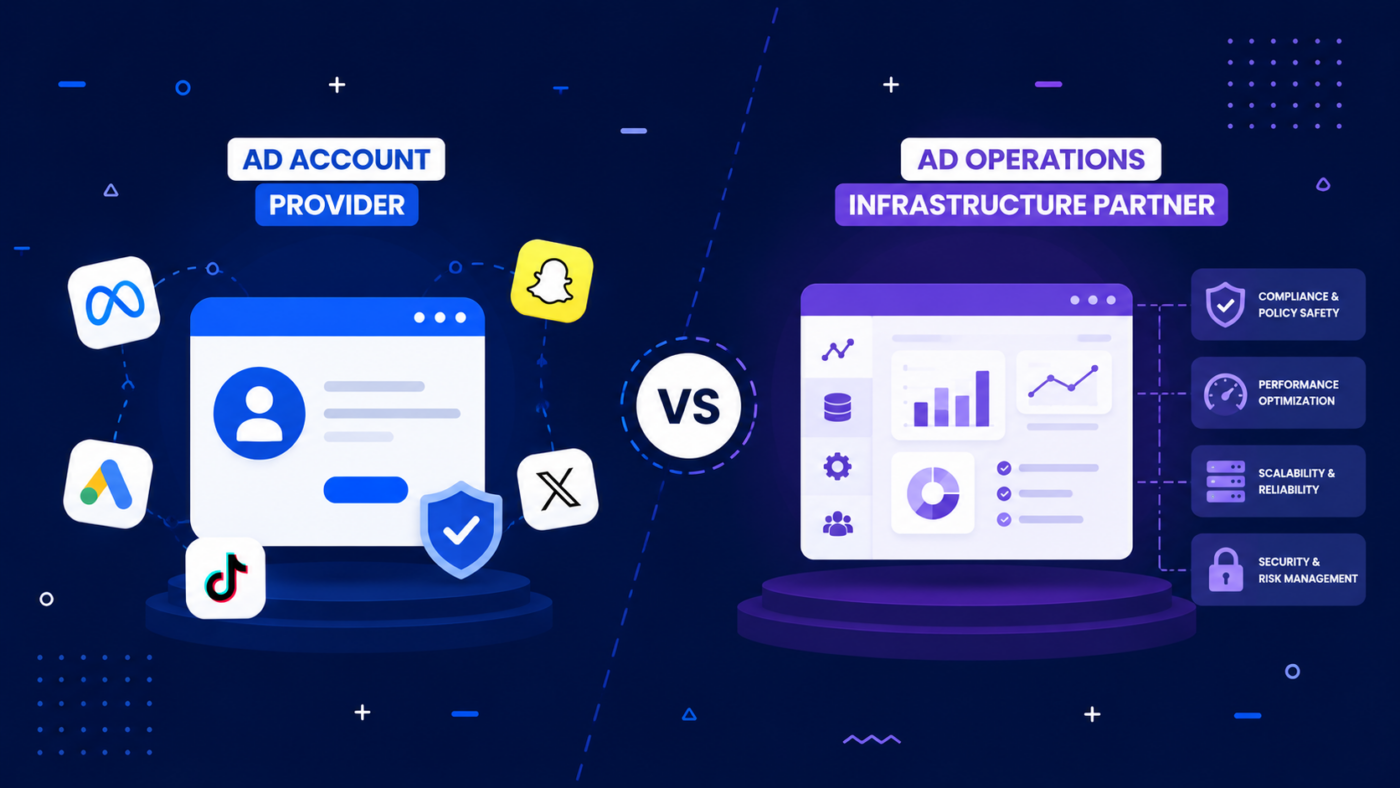
9 June 2026
Ad Account Provider vs Ad Operations Infrastructure Partner: What’s the Difference?
For many advertisers, access is the first problem they try to solve.
A brand wants to scale on Meta, TikTok, Google, or other major platforms. An agency needs to manage campaigns for multiple clients. An ecommerce team wants to increase spend without interruptions. At that point, the search often starts with a simple question: Which ad account provider should we use?
That question is understandable. Ad account access matters. Without the right account setup, advertisers may struggle with spend limits, payment friction, operational delays, or fragmented workflows.
But access alone is not the full picture.
As advertising budgets grow, teams usually need more than an ad account. They need continuity, control, payment readiness, support, reporting, automation, and a workflow that can handle scale. This is where the difference between an ad account provider and an ad operations infrastructure partner becomes important.
An ad account can solve access. Infrastructure solves continuity, control, support, payment flow, reporting, and scale.
What is an ad account provider?
An ad account provider typically helps advertisers access advertising accounts for platforms such as Meta, TikTok, Google, or other major channels. The main value is account availability.
For some advertisers, this may be enough. A small team may simply need an account to start running campaigns. An agency may need additional accounts to support client operations. An ecommerce brand may need more account flexibility during growth periods.
In this model, the focus is usually on access: getting the advertiser into an account environment where campaigns can be launched and managed.
Common expectations from an ad account provider may include:
– Access to advertising accounts
– Account setup support
– Platform availability across major channels
– Basic account management
– Spend and billing support
– Replacement or backup account options, depending on the provider model
These capabilities can be useful, especially when advertisers are dealing with account-level limitations or operational complexity. But for high-spend advertisers, access is only one part of the operating system.
Where ad account access becomes limited
Ad account access can help teams start or continue campaign activity, but it does not automatically solve every operational challenge.
A team may have access to an account and still struggle with payment issues. Campaigns may still pause if billing workflows are not reliable. Reporting may still be fragmented across platforms. Agencies may still spend hours managing client accounts manually. Ecommerce brands may still waste budget on products that are out of stock. High-spend advertisers may still lack visibility across balances, budgets, and campaign operations.
This is where many teams realize that the real challenge is not only account access. The real challenge is managing the operational layer around the account.
That operational layer includes:
– Payment continuity
– Balance and spend visibility
– Account stability
– Policy-aware support
– Cross-platform workflows
– Campaign reporting
– Team access and permissions
– Automation rules
– Bulk campaign creation
– Faster issue resolution
– Multi-client or multi-brand operations
When these needs appear, a traditional ad account provider may not be enough.
What is an ad operations infrastructure partner?
An ad operations infrastructure partner supports the systems and workflows that help advertisers run paid campaigns at scale.
Instead of focusing only on account access, this type of partner helps advertisers manage the broader operating environment behind paid media. That may include ad account infrastructure, payment continuity, reporting, automation, platform support, campaign control, and workflow efficiency across multiple ad platforms.
For high-spend advertisers, this distinction matters because scaling is rarely blocked by one single issue. Growth can be slowed down by payment interruptions, account limitations, delayed launches, manual campaign setup, unclear reporting, or disconnected operations between finance and media buying teams.
An ad operations infrastructure partner is designed to reduce these bottlenecks.
The goal is not simply to provide access. The goal is to help campaigns keep running with more continuity, visibility, and control.
The key difference: access vs continuity
The simplest way to understand the difference is this:
An ad account provider helps advertisers access ad accounts.
An ad operations infrastructure partner helps advertisers operate, fund, monitor, and scale campaigns through those accounts.
That difference becomes more important as spend increases.
A low-spend advertiser may be able to manage account access, payment setup, reporting, and optimization manually. A high-spend team usually cannot afford that level of fragility. When budgets increase, every operational weakness becomes more expensive.
If payment fails, campaigns can stop.
If reporting is fragmented, decisions slow down.
If campaign launches are manual, testing volume suffers.
If support is unclear, issue resolution becomes stressful.
If teams cannot move quickly, growth opportunities are missed.
Infrastructure is what helps prevent these problems from becoming recurring blockers.
When does a brand need more than an ad account provider?
A brand may need more than an ad account provider when paid media becomes operationally complex.
This usually happens when the brand is spending heavily, expanding into new markets, managing multiple platforms, working with several accounts, or preparing for peak sales periods. It can also happen when the brand needs tighter coordination between finance, media buying, reporting, and campaign execution.
Signs that a brand may need ad operations infrastructure include:
– Campaigns are affected by payment interruptions
– The team manages multiple ad accounts or platforms
– Spend is increasing faster than internal workflows can support
– Finance and media buying teams are not fully aligned
– Reporting is scattered across platforms
– Campaign launches require too much manual work
– The team needs better visibility into balances and spend
– Product or inventory changes are not reflected in ad workflows
– Agencies or internal teams need faster bulk campaign creation
– Account issues create repeated operational delays
At this point, the question should change from “Where can we get an account?” to “What infrastructure do we need to operate campaigns reliably at scale?”
Why payment continuity is part of infrastructure
Payment continuity is one of the clearest differences between simple account access and operational infrastructure.
An advertiser may have an account, but if the payment workflow is fragile, campaigns can still stop. This is especially important for high-spend advertisers, agencies, and ecommerce brands that rely on consistent campaign delivery.
Payment continuity means the advertiser has systems and workflows in place to reduce the risk of billing-related interruptions. This can include multiple payment options, balance monitoring, funding visibility, finance coordination, and support when payment issues occur.
For high-spend teams, payment continuity is not just a finance concern. It is a campaign delivery concern.
A strong infrastructure partner understands that billing, spend flow, and campaign performance are connected. If spend cannot move reliably, scaling becomes harder.
Why agencies need operational support, not just accounts
Agencies often feel the difference between account access and infrastructure faster than individual advertisers because they manage complexity across multiple clients.
An agency may need to launch campaigns for several clients, monitor different budgets, manage separate billing workflows, respond to account issues, create large numbers of ad variations, and report performance across platforms. If each task is handled manually, operations become a bottleneck.
An ad account provider can support access. But an ad operations infrastructure partner can support the wider workflow.
For agencies, this may include:
– Multi-client account operations
– Payment and balance visibility
– Faster campaign launch workflows
– Bulk ad creation
– Reporting support
– Automation rules
– Role-based team access
– Clear issue escalation
– Cross-platform campaign control
This helps agencies spend less time firefighting operational issues and more time improving client performance.
Why ecommerce brands need a stronger operational layer
Ecommerce brands face their own set of operational challenges.
Product availability changes. Promotions start and end. Margins shift. Inventory can run out. Demand can spike quickly during seasonal campaigns, launches, or discount periods. If advertising workflows are disconnected from store operations, teams may waste budget or miss opportunities.
This is why ecommerce brands often need more than account access. They need ad operations that can respond to what is happening inside the business.
For example, Shopify-connected ad automation can help teams use store signals, product updates, and inventory status to inform advertising decisions. Bulk campaign workflows can help teams launch more creative variations faster. Payment continuity can help protect campaigns during high-demand sales periods.
In ecommerce, the account is only one part of the system. The stronger advantage comes from connecting account access, payments, reporting, automation, and store-aware workflows.
What should advertisers compare before choosing a partner?
Advertisers should avoid comparing providers only by whether they can provide account access. That is too narrow.
A more useful evaluation framework should include:
Account access:
Which platforms are supported? Can the provider support the advertiser’s scale, markets, and account needs?
Payment continuity:
Can the setup support high spend without avoidable billing interruptions? Are there multiple payment options and clear funding workflows?
Operational support:
Is there a process for resolving account, payment, or campaign issues? How quickly can support respond when campaigns are at risk?
Reporting and visibility:
Can the team monitor spend, balances, campaign activity, and account-level performance clearly?
Automation capabilities:
Can the partner help reduce manual work through rules, workflows, or integrations?
Bulk campaign workflows:
Can agencies or high-volume teams launch campaigns and ads faster without losing structure and control?
Platform fit:
Does the partner support the channels that matter most, such as Meta, TikTok, Google, or other major ad platforms?
Compliance-aware approach:
Does the partner use responsible, policy-aware language and support advertisers in maintaining healthier operations?
Business fit:
Is the partner built for beginners, small advertisers, agencies, ecommerce brands, or high-spend teams?
The best choice depends on the advertiser’s stage, spend level, internal team structure, and operational complexity.
Why this difference matters for high-spend advertisers
High-spend advertisers cannot treat ad operations as a small back-office function. When budgets grow, operational problems become more expensive.
A payment issue can interrupt revenue.
A reporting gap can slow down decisions.
Manual campaign setup can reduce testing velocity.
Poor account visibility can create unnecessary risk.
Weak support can turn small issues into major delays.
This is why high-spend advertisers need to think beyond account access. They need the infrastructure that keeps paid media running smoothly.
In that context, the right partner is not just the one that helps you get into an ad account. It is the one that helps you keep campaigns moving with more continuity, control, and operational confidence.
The future of paid media operations
Paid media is becoming more complex. Advertisers are managing more channels, more markets, more creative variations, more payment workflows, and more data sources than before.
As this complexity increases, the operational layer behind advertising becomes more important.
The next generation of advertising support will not be defined only by access. It will be defined by the ability to connect access with payments, automation, reporting, support, and campaign control.
That is the difference between an ad account provider and an ad operations infrastructure partner.
One helps you start.
SHARE