 ENGLISH
 TÜRKÇE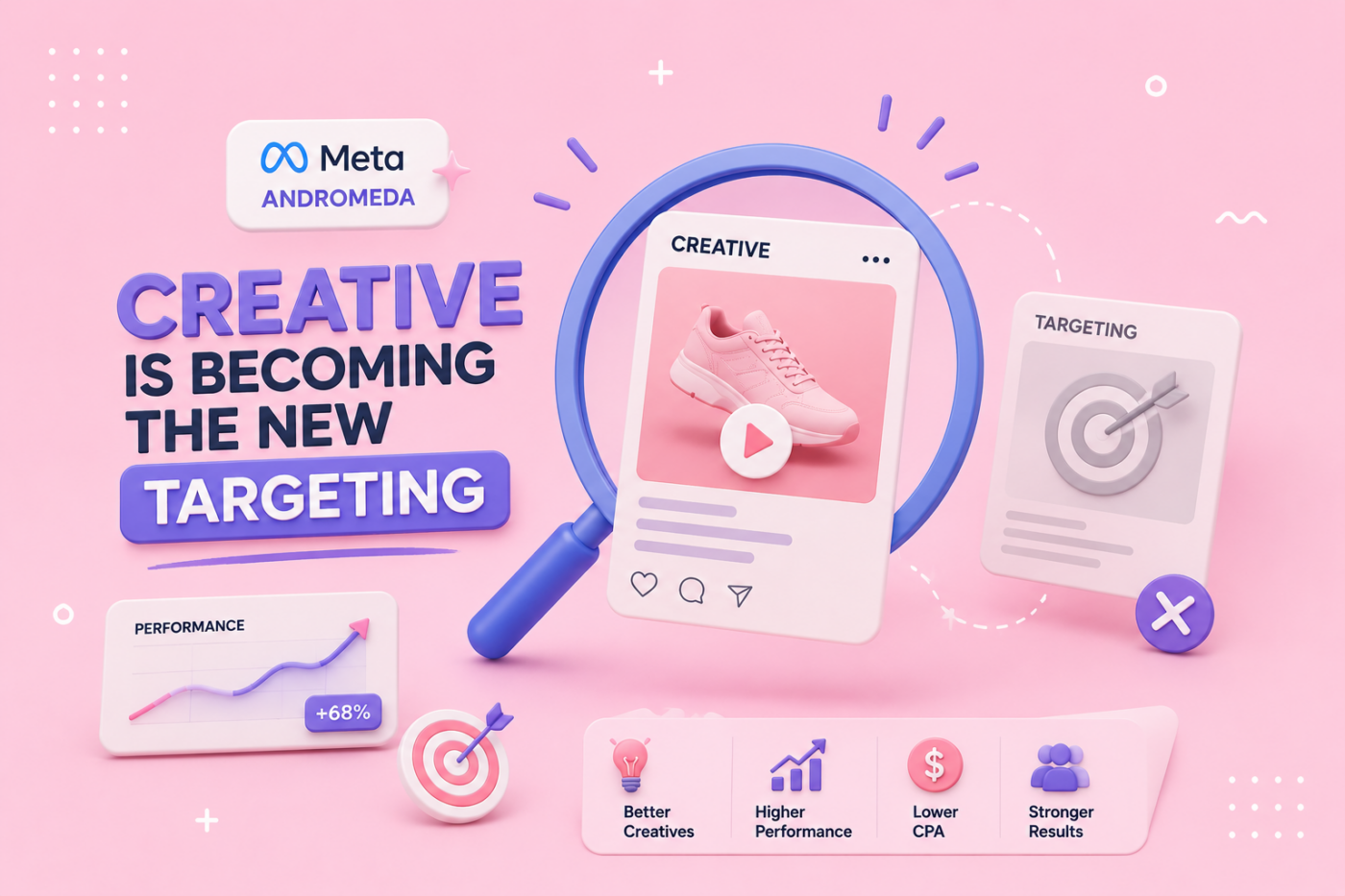
After Meta Andromeda: Creative Is Becoming the New Targeting for Meta Ads
Meta Ads has been moving toward automation for years.
Manual targeting has become less central. Advantage+ campaigns, broader audiences, AI-driven delivery, and automated optimization have changed how advertisers think about performance. Instead of building narrow audience stacks and controlling every targeting detail manually, advertisers now need to give Meta’s system stronger signals to work with.
One of the most important signals is creative.
After Meta Andromeda, this shift becomes even more important. Meta describes Andromeda as a personalized ads retrieval engine built to improve how ads are selected and matched to people across its apps. It is designed to support more advanced machine learning in the ad retrieval stage and help Meta process a much larger and more diverse set of ads more efficiently.
For advertisers, the practical takeaway is simple:
- Creative is no longer only the message.
- Creative is becoming part of the targeting system.
The hooks, angles, formats, product stories, pain points, benefits, visuals, and offers inside your ads help Meta understand who each ad may be relevant for. In a more automated environment, creative diversity becomes one of the main ways advertisers influence delivery.
But there is another part of the story that many brands miss.
More creative volume also creates more operational pressure.
If brands want to scale Meta Ads after Andromeda, they need both sides of the system:
- A creative strategy built for AI-driven delivery
- An operational setup that keeps campaigns live, funded, visible, and scalable
Creative may now carry more of the targeting signal, but infrastructure still decides whether that creative can keep running, learning, and scaling.
What Is Meta Andromeda?
Meta Andromeda is a personalized ads retrieval engine introduced by Meta to improve ad selection and personalization across Facebook and Instagram. Meta explains that Andromeda supports the ads retrieval stage, helping the system process a much larger number of potential ad candidates and use more advanced machine learning to improve ad relevance and performance.
In simple terms, retrieval is the stage where Meta narrows down which ads may be relevant enough to be considered for a person before the final ranking and auction process.
This matters because advertisers are now operating in a system where machine learning decides more of the delivery process.
Meta’s own explanation also connects Andromeda with the growth of Advantage+ automation and creative diversity. As advertisers use more automated tools and generate more creative variations, Meta needs a more advanced system to retrieve and match the right ads to the right people.
For advertisers, this does not mean that strategy disappears. It means strategy moves.
Instead of over-controlling audiences manually, advertisers need to focus more on the inputs that help the system learn: creative, product signals, landing pages, offers, campaign structure, and operational consistency.
Why Creative Is Becoming the New Targeting
In older Meta Ads workflows, advertisers often spent a lot of time building detailed audience segments.
They would separate interest groups, lookalikes, retargeting pools, demographic layers, and manual audience tests. Creative mattered, but targeting structure often carried much of the strategy.
That world has changed.
With broader audiences and AI-driven delivery, Meta’s system increasingly uses creative signals to understand relevance. The same product can be positioned in different ways for different customer motivations.
For example, a skincare brand can create different ads around:
- Acne concerns
- Sensitive skin
- Anti-aging
- Clean ingredients
- Dermatologist-backed proof
- Before/after transformation
- Morning routine
- Price-value comparison
- Giftability
- Social proof
Each creative angle helps the system understand a different buying context.
This is why creative is becoming targeting.
Not because manual targeting no longer matters at all, but because creative now carries more of the signal that helps Meta find the right audience.
The ad tells the system who it is for.
What This Means for Ecommerce Brands
For ecommerce brands, Andromeda changes the practical meaning of creative testing.
It is no longer enough to create small variations of the same message.
Changing the background color, swapping the first frame, or slightly adjusting the headline may not create enough signal diversity. Brands need meaningful creative variation.
That means testing different:
- Customer problems
- Product benefits
- Personas
- Use cases
- Hooks
- Formats
- Proof points
- Offers
- Product bundles
- Landing page angles
- Market-specific messages
The goal is not simply to produce more ads.
The goal is to produce more useful signals.
Meta’s system needs creative diversity that represents different reasons people may care about the product. Strong creative strategy gives the algorithm more paths to find demand.
For ecommerce teams, this creates a new operating reality:
Creative strategy, campaign structure, product priorities, and operational readiness need to work together.
The Practical Playbook: How to Adapt Meta Ads After Andromeda
1. Build Creative Around Customer Problems
Instead of starting only with product features, start with customer problems.
A good creative system should map different problems to different ads.
For example:
- “I need this fast”
- “I want better results”
- “I am tired of wasting money”
- “I need something simple”
- “I want a premium alternative”
- “I need proof before buying”
- “I want this for a specific occasion”
Each problem can become a different creative angle.
This helps Meta understand different demand patterns instead of seeing every ad as a similar product pitch.
2. Create Persona-Based Creative Angles
Broad targeting does not mean broad messaging.
A campaign can target broadly while the creative speaks to specific customer types.
For example, an ecommerce brand could create different Meta Ads for:
- First-time buyers
- Returning customers
- Gift shoppers
- Price-sensitive shoppers
- Premium buyers
- Problem-aware customers
- Comparison shoppers
- Urgency-driven shoppers
- New market audiences
Each persona angle gives the system a different relevance signal.
3. Diversify Formats, Not Just Messages
Creative diversity is not only about copy.
Brands should also test different formats:
- UGC-style videos
- Product demos
- Founder-led videos
- Testimonial ads
- Before/after concepts
- Problem-solution videos
- Static product ads
- Comparison ads
- Carousel ads
- Offer-led creatives
- Educational explainers
- Short-form native content
Different formats can unlock different audiences and behaviors.
A person who ignores a polished product ad may respond to a raw testimonial. A person who skips UGC may engage with a comparison creative.
Format diversity gives Meta more ways to match ads with people.
4. Build a Product-Benefit Matrix
Ecommerce brands should connect products with the specific benefits they want to test.
A simple matrix can include:
- Product
- Primary benefit
- Secondary benefit
- Customer problem
- Proof point
- Best format
- Target market
- Landing page angle
- Offer
- Creative status
This helps teams avoid random creative production.
Instead of asking, “What ad should we make next?” teams can ask, “Which product-benefit signal are we missing?”
That is a better way to build creative for an AI-driven delivery system.
5. Localize Creative for Market Expansion
Global Meta scaling requires more than translating ad copy.
Different markets may respond to different:
- Pain points
- Visual styles
- Pricing messages
- Proof points
- Cultural references
- Product benefits
- Buying objections
- Trust signals
If ecommerce brands want to scale globally, they need localized creative signals that help Meta understand relevance in each market.
Creative localization is not just a brand exercise.
It is a delivery signal.
6. Keep Testing Structured
More creative does not automatically mean better performance.
Without structure, creative testing becomes messy. Teams may launch too many unrelated ads, lose track of what is being tested, or misread results.
A better approach is to organize tests by:
- Hook
- Problem
- Persona
- Product
- Benefit
- Format
- Offer
- Market
- Funnel stage
This makes reporting cleaner and helps teams understand what is actually working.
A strong creative system should create learning, not just volume.
7. Protect the Learning Process
Meta’s system needs stable delivery to learn.
If campaigns are constantly interrupted, paused, duplicated, restructured, or affected by payment problems, creative testing becomes harder to interpret.
This is where many brands underestimate operations.
The creative engine needs continuity.
Campaigns need enough time, budget, and stability to produce meaningful signals. If operational issues keep breaking delivery, the brand may never learn whether the creative strategy actually worked.
The Part Most Brands Miss: Operational Readiness
Andromeda makes creative diversity more important, but it also increases operational complexity.
More creative angles usually mean:
- More ads
- More campaigns
- More tests
- More naming structures
- More reporting needs
- More budget movement
- More approval workflows
- More platform activity
- More operational risk
At low spend, these issues may feel manageable.
At high spend, they can become growth bottlenecks.
A brand may have strong creatives, strong products, and a strong offer, but still struggle to scale if the operational setup behind Meta Ads is weak.
Common operational blockers include:
- Payment failures
- Billing interruptions
- Account access issues
- Spend limitations
- Delayed support
- Fragmented reporting
- Manual workflows
- Lack of campaign continuity planning
- Poor finance and marketing alignment
- Slow reaction time during peak campaigns
These problems can interrupt delivery, delay testing, and reduce the reliability of performance data.
After Andromeda, brands should not only ask:
“Do we have enough creative?”
They should also ask:
“Can our operations support the creative volume we are about to launch?”
Why Payment Continuity Matters More When Creative Volume Increases
Creative testing depends on delivery.
If campaigns stop because of payment issues, the testing system breaks. Teams may lose learning momentum, delay optimization decisions, and miss demand during important campaign periods.
For ecommerce brands, this can be especially costly during:
- Product launches
- Seasonal campaigns
- Influencer-driven demand spikes
- Black Friday/Cyber Monday
- New market launches
- Limited-time promotions
- High-spend scaling periods
Payment continuity is not just a billing topic. It is part of campaign continuity. When payments break, campaign learning can break with them. If brands are producing more creative and increasing Meta budgets, they need a payment workflow that can support that growth.
Why Account Stability Still Matters in an AI-Driven Meta System
As Meta becomes more automated, some advertisers assume operations matter less. The opposite is true.
Automation performs better when the inputs are stable. Campaigns need consistent delivery, clean structures, reliable access, clear reporting, and fast support when issues appear.
Account stability matters because high-spend advertisers cannot afford unnecessary interruptions.
If the account setup is unstable, teams may lose time solving operational issues instead of improving creative, product, and campaign strategy.
Meta’s system can help match creative to people, but it cannot fix a broken operating setup behind the advertiser.
What to Check Before Scaling Meta Ads After Andromeda
Before increasing budgets or launching more creative variations, ecommerce teams should review their operational foundation.
Creative Readiness
- Do we have enough meaningful creative diversity?
- Are we testing different problems, personas, benefits, and formats?
- Do we have a structured creative testing system?
- Are our creative learnings easy to read?
- Are we localizing for new markets?
Campaign Readiness
- Is our campaign structure clean?
- Do we know what each test is designed to learn?
- Are naming conventions clear?
- Can we report by product, market, persona, and angle?
- Can we scale winners without losing control?
Payment Readiness
- Can our payment workflow support higher spend?
- Do we have visibility into balances and billing status?
- Can campaigns stay live during peak periods?
- Are finance and marketing aligned before budget increases?
- Do we have a plan for payment interruptions?
Operational Readiness
- Do we have reliable platform access?
- Do we have fast support when issues appear?
- Is reporting clear across accounts and markets?
- Can the team manage higher creative and campaign volume?
- Can our operational setup support global scaling?
The stronger the operating system, the more confidently teams can scale creative testing.
How Rockads Supports Meta Scaling After Andromeda
Rockads helps high-spend advertisers, agencies, and ecommerce brands support the operational layer behind scalable Meta Ads growth.
Rockads is not a creative agency or a traditional media buying agency. It does not replace the need for strong creative strategy. Instead, Rockads supports the systems that help campaigns keep running, learning, and scaling.
For teams increasing Meta spend after Andromeda, Rockads supports:
- Reliable platform access
- Payment continuity
- Campaign continuity
- Reporting and visibility
- Operational support
- Multi-platform campaign control
- Support for high-spend advertising operations
This matters because a stronger creative strategy creates more operational demand.
More ads need more structure.
More tests need more visibility.
More spend needs stronger payment workflows.
More markets need better operational control.
Rockads helps teams keep the background systems behind advertising stable while they focus on growth.
Creative Is the Signal. Operations Keep the Signal Running.
The biggest shift after Andromeda is not that creative suddenly matters. Creative has always mattered.
The shift is that creative now carries more of the targeting signal inside an increasingly automated Meta Ads system. This creates a major opportunity for ecommerce brands. Teams that build stronger creative systems can give Meta better inputs and unlock more scalable learning.
But creative alone is not enough.
If campaigns are interrupted, if payments fail, if reporting is unclear, or if account stability is weak, the creative engine cannot work properly. The brands that win after Andromeda will not only produce more ads. They will build the systems that allow those ads to run, learn, and scale.
Final Thoughts
After Meta Andromeda, advertisers need to rethink how they approach Meta Ads scaling.
Manual targeting is becoming less central. Creative diversity is becoming more important. The strongest advertisers will build creative systems around customer problems, personas, formats, product benefits, and market-specific signals.
But the operational layer matters just as much.
A campaign can only learn if it keeps running. A creative system can only scale if the account, payment, reporting, and support systems behind it are stable.
Creative may be becoming the new targeting. But campaign continuity is what allows creative to become performance. For high-spend advertisers and ecommerce brands, the future of Meta Ads scaling belongs to teams that combine creative diversity with operational readiness.
FAQ
What is Meta Andromeda?
Meta Andromeda is a personalized ads retrieval engine built to improve how Meta selects and matches ads to people across its apps. Meta describes it as part of the ad retrieval stage, helping the system process more ad candidates and use more advanced machine learning for personalization and performance.
How does Andromeda affect Meta Ads targeting?
Andromeda supports a more automated and AI-driven ad delivery system. For advertisers, this means creative signals become more important because Meta uses ad content, relevance, and performance signals to help determine who may respond to each ad.
Is creative really the new targeting on Meta?
Creative is becoming a more important targeting signal on Meta. As manual targeting becomes less central and automated delivery becomes more advanced, the hooks, angles, formats, product stories, and benefits inside creative help Meta understand who the ad may be relevant for.
Does Andromeda mean manual targeting no longer matters?
No. Manual targeting can still matter in certain cases, but advertisers should not rely only on narrow audience structures. In a more automated Meta Ads environment, creative diversity, offer quality, product signals, landing pages, and campaign structure all become important inputs.
What should ecommerce brands change after Andromeda?
Ecommerce brands should build more structured creative systems. This includes testing different customer problems, personas, product benefits, formats, hooks, offers, and localized messages. They should also make sure their operational setup can support higher creative and campaign volume.
Why does creative diversity matter for Meta Ads?
Creative diversity gives Meta more signals to understand different customer motivations and match ads with relevant audiences. Different creative angles can reach different buying contexts, even when campaigns use broad or automated targeting.
Why does operational readiness matter after Andromeda?
Operational readiness matters because more creative volume creates more campaign complexity. Brands need stable account access, payment continuity, reporting, support, and campaign control to keep ads running, learning, and scaling.
How do payment issues affect Meta Ads scaling?
Payment issues can interrupt campaign delivery. When campaigns stop or slow down, advertisers can lose sales, learning momentum, testing stability, and time-sensitive growth opportunities. For high-spend advertisers, payment continuity is part of campaign continuity.
Is Rockads a Meta Ads creative agency?
No. Rockads is not a Meta Ads creative agency. Rockads supports the operational systems behind paid media growth, helping teams keep campaigns live, funded, visible, and scalable.
Is Rockads an ad network or DSP?
No. Rockads is not an ad network or DSP. Rockads is an ad operations infrastructure partner that supports platform access, payment continuity, campaign continuity, reporting, and operational support for advertisers scaling paid media.
SHARE