 ENGLISH
 TÜRKÇE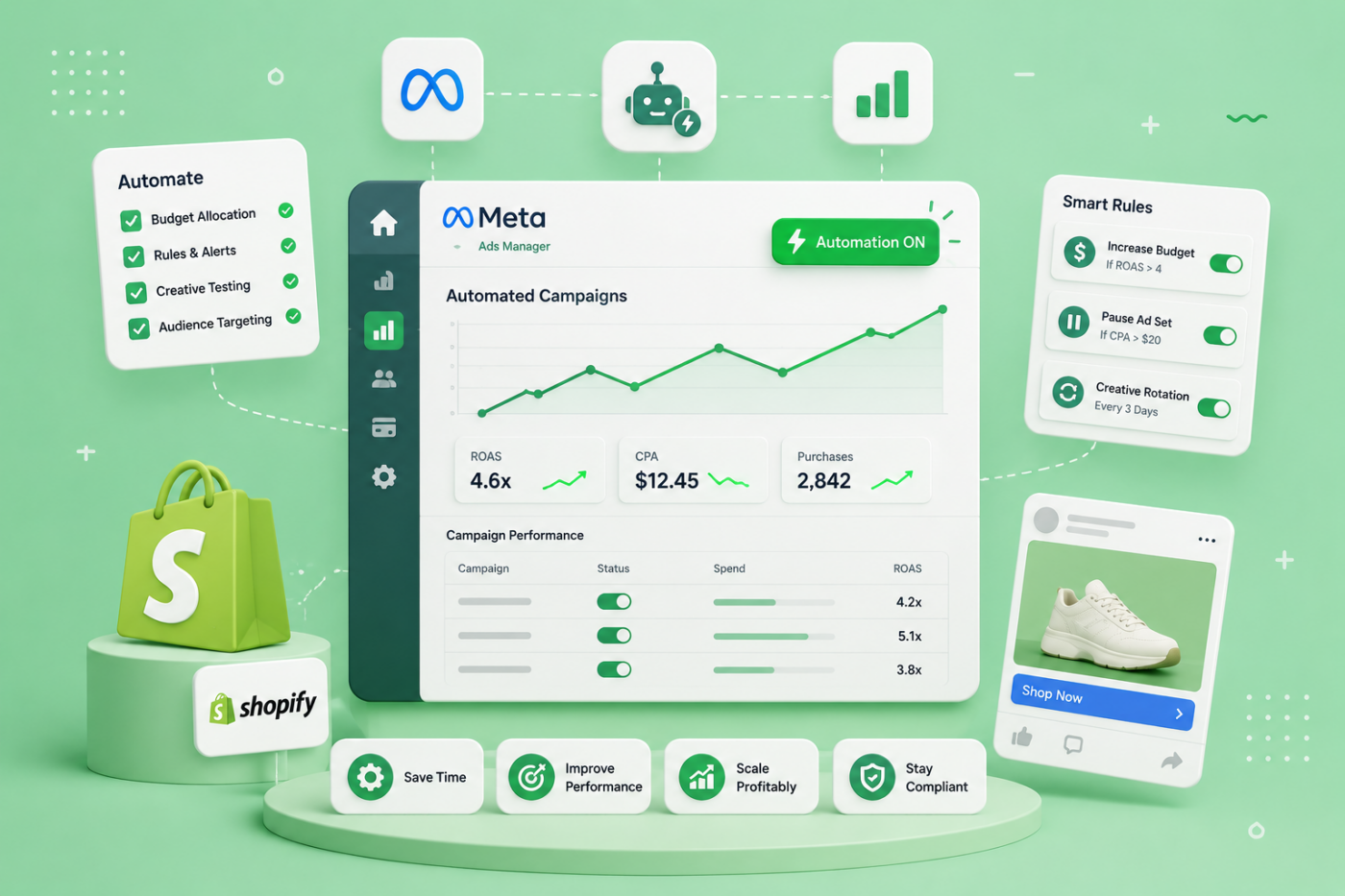
6 July 2026
Best Meta Ads Automation Tools for Shopify Stores: What Ecommerce Teams Should Look For Before Scaling
For Shopify stores, Meta Ads can be one of the strongest growth channels. It helps ecommerce brands reach new customers, retarget existing visitors, promote product launches, and scale revenue across markets.
But as campaign volume grows, managing Meta Ads manually becomes harder.
Teams need to create more campaigns, test more products, monitor more creative variations, control budgets, track performance, and react quickly when store conditions change. A product may sell out. A best-seller may suddenly gain momentum. A campaign may continue spending on an item that is no longer available. A new collection may need budget support faster than the team can manually update campaigns.
This is why Meta Ads automation matters for Shopify stores.
The best Meta Ads automation tools do more than save time. They help ecommerce teams connect ad decisions with store reality: product performance, inventory status, store activity, campaign results, and operational workflows.
For growing Shopify brands, automation is not only about launching ads faster. It is about building a more scalable advertising operation.
What Is Meta Ads Automation for Shopify?
Meta Ads automation for Shopify refers to tools and workflows that help ecommerce teams manage Meta campaigns with less manual effort and more store-aware decision-making.
Instead of adjusting every campaign, product, budget, or rule manually, teams can use automation to support repetitive tasks, campaign monitoring, product-level decisions, reporting, and optimization workflows.
For Shopify stores, this is especially valuable because ad performance is closely connected to what happens inside the store.
A campaign decision should not depend only on metrics inside Meta Ads Manager. Ecommerce teams also need to consider:
- Which products are selling
- Which products are low in stock
- Which products are out of stock
- Which collections are gaining demand
- Which items have strong margins
- Which campaigns are spending on unavailable products
- Which store events should trigger campaign adjustments
This is where Shopify-connected Meta Ads automation becomes important.
It allows teams to move beyond campaign-level optimization and use store-level signals to support smarter advertising decisions.
Why Shopify Stores Need Meta Ads Automation
Shopify brands often start with manual campaign management. At the beginning, this can work. A small number of campaigns, products, and audiences may be manageable for one marketer or a small team.
But as the store grows, manual workflows become a bottleneck.
A scaling ecommerce team may need to manage:
- Multiple products
- Multiple markets
- Multiple audiences
- Multiple creative variations
- Multiple promotions
- Seasonal campaigns
- Product launches
- Retargeting flows
- Catalog campaigns
- Budget changes
- Inventory changes
- Reporting needs
Without automation, teams can lose time on repetitive operational work instead of focusing on strategy, creative testing, and growth decisions.
Meta Ads automation helps Shopify brands reduce manual work and respond faster to changes in both campaign performance and store activity.
The Problem With Campaign-Level Optimization Alone
Most ad optimization happens inside the ad platform.
Teams look at ROAS, CPA, CTR, CPM, conversion rate, purchase volume, and spend. These metrics are useful, but they do not tell the full ecommerce story.
A campaign can look healthy inside Meta while creating problems for the store.
For example:
- A campaign may keep spending on a product that is nearly out of stock.
- A product may have strong ad performance but weak margin.
- A collection may be trending in the store but under-supported in campaigns.
- A product may be sold out while still receiving ad spend.
- A new product may need campaign visibility faster than manual workflows allow.
This is why Shopify stores need store-level optimization.
Store-level optimization means using ecommerce signals, not only ad platform metrics, to support campaign decisions.
For Shopify brands, this can include product performance, inventory status, store activity, collection-level performance, order behavior, and product availability.
The stronger the connection between store data and ad operations, the easier it becomes to reduce wasted spend and support better campaign decisions.
Key Features to Look For in Meta Ads Automation Tools for Shopify
Not every automation tool is built for the same use case. Some focus on campaign rules. Some focus on creative generation. Some focus on analytics. Some focus on bidding. Others focus on ecommerce workflows.
For Shopify stores, the most useful Meta Ads automation tools usually support several of the following capabilities.
1. Shopify Integration
A strong Meta Ads automation setup should connect with Shopify data.
This allows campaign workflows to respond to what is happening inside the store, not only inside the ad account.
Important Shopify signals may include:
- Product performance
- Inventory status
- Product availability
- Store activity
- Sales trends
- Collection performance
- Product-level demand
- Order behavior
For ecommerce teams, this connection is critical because advertising decisions should reflect actual business conditions.
2. Store-Level Optimization
Store-level optimization helps teams make ad decisions based on product and store signals.
This is especially important for Shopify stores with multiple products, fast-changing inventory, seasonal campaigns, or high-volume advertising activity.
Examples of store-level optimization questions include:
- Are we spending on products that are out of stock?
- Which products deserve more budget support?
- Which items are performing well in the store but under-supported in ads?
- Are campaign decisions aligned with product availability?
- Are we wasting spend on products that cannot convert efficiently?
Campaign-level data matters. But store-level data gives ecommerce teams a more complete view.
3. Automated Campaign Workflows
Automation should reduce repetitive campaign management tasks.
This can include:
- Campaign setup workflows
- Product-based campaign actions
- Rule-based optimizations
- Budget adjustments
- Ad pausing workflows
- Campaign monitoring
- Alert systems
- Performance checks
The goal is not to remove human strategy. The goal is to reduce manual work so teams can operate faster and with more control.
4. Bulk Ad Creation
Bulk ad creation is useful for brands and agencies managing high campaign volume.
When teams need to launch many ad variations, products, or market-specific campaigns, manual setup can slow down testing and execution.
Bulk workflows can help teams:
- Launch more ad variations faster
- Reduce repetitive setup work
- Support creative testing
- Manage product-level campaigns
- Improve campaign launch speed
- Keep campaign structures more organized
For agencies and high-volume ecommerce teams, this can become a major operational advantage.
5. Reporting and Visibility
Automation is not only about taking action. It is also about seeing what is happening.
Shopify stores need clear reporting across campaign performance, spend, product activity, and store signals.
Strong reporting helps teams understand:
- Which campaigns are driving results
- Which products are receiving spend
- Which products are converting
- Where spend may be wasted
- Which store signals should influence campaign decisions
- How campaign activity connects to ecommerce performance
Without visibility, automation can create more complexity instead of solving it.
6. Campaign Control
As ecommerce brands scale, campaign control becomes more important.
Automation should help teams move faster without losing structure. The best systems allow teams to manage campaign workflows, product rules, reporting, and optimization logic in a controlled way.
For high-spend advertisers, this matters because small mistakes can become expensive when campaign volume and budgets increase.
7. Operational Support
For larger advertisers, automation alone may not be enough.
Teams may also need operational support, platform know-how, payment continuity, and campaign continuity support.
This is where automation becomes part of a broader ad operations infrastructure.
For growing Shopify brands, the question is not only:
“Which tool can automate Meta Ads?”
It is also:
“Which solution can support the operational layer behind scaling paid media?”
Best Meta Ads Automation Tools for Shopify Stores: Comparison Framework
The right tool depends on the brand’s size, campaign complexity, store setup, and growth stage.
Below is a practical framework for comparing Meta Ads automation tools for Shopify stores.
|
Tool Category |
Best For |
Strengths |
Limitations |
|---|---|---|---|
|
Rule-Based Automation Tools |
Teams that need basic campaign rules |
Budget rules, pausing logic, simple workflow automation |
May not connect deeply with store-level business signals |
|
Creative Automation Tools |
Teams producing many creative variations |
Creative testing, ad generation, asset production |
May not solve operational, payment, or store-level optimization needs |
|
Analytics and Attribution Tools |
Teams that need better performance visibility |
Reporting, attribution, customer journey insights |
May not directly manage campaign operations |
|
Shopify Ad Automation Tools |
Ecommerce teams needing store-aware workflows |
Product signals, inventory awareness, store-level optimization |
Capabilities vary depending on integration depth |
|
Bulk Ad Creation Tools |
Agencies and high-volume advertisers |
Faster setup, structured launches, campaign variation management |
Need strong controls to avoid messy execution |
|
Ad Operations Infrastructure Partners |
High-spend teams scaling across products, markets, and platforms |
Automation, reporting, platform access, payment continuity, support, campaign control |
Best suited for teams that need broader operational support, not only lightweight automation |
This distinction matters.
A small Shopify store may only need basic automation rules. A larger ecommerce brand may need a stronger system that connects automation with campaign control, store data, payment continuity, reporting, and operational support.
Where Rockads Fits
Rockads supports ecommerce brands, agencies, and high-spend advertisers with automation technology as part of a broader ad operations infrastructure.
Rockads is not only an ad automation tool. It combines automation with the operational layer advertisers need to scale paid media with more continuity, visibility, and control.
For Shopify stores, Rockads’ ad automation capabilities and Shopify integration help teams move beyond campaign-level optimization and use store signals such as product performance, inventory status, and store activity to support smarter advertising decisions.
Rockads helps connect paid media operations with ecommerce reality.
This means teams can think beyond isolated ad platform metrics and build workflows around what is actually happening inside the business.
Rockads can support:
- Shopify-connected ad automation
- Store-level optimization
- Product performance signals
- Inventory-aware advertising workflows
- Bulk ad creation
- Campaign control
- Reporting and operational visibility
- Platform access
- Payment continuity
- Operational support for scaling teams
For ecommerce advertisers, this makes Rockads especially relevant when automation needs to connect with broader advertising operations.
When Should a Shopify Store Invest in Meta Ads Automation?
A Shopify store should consider Meta Ads automation when manual campaign management starts limiting growth.
Common signs include:
- The team manages many products or campaigns
- Campaign setup takes too much time
- Products go out of stock while ads keep spending
- Reporting is fragmented
- Store data is not influencing ad decisions
- Budget changes require too much manual work
- The team needs faster testing workflows
- Agencies need to launch ads at higher volume
- Campaign decisions are disconnected from product performance
- The brand is preparing to increase Meta Ads spend
Automation becomes more valuable as campaign complexity increases.
For ecommerce brands, the goal is not just to automate tasks. The goal is to create a smarter connection between campaigns, products, inventory, and business performance.
How Shopify Store Data Can Improve Meta Ads Decisions
Shopify store data can help advertisers make more informed campaign decisions.
Ad platform data shows how campaigns perform. Shopify data shows what is happening in the business.
Together, they can support better decisions.
For example:
- Product performance can help teams decide what to promote.
- Inventory status can help teams avoid wasting spend on unavailable products.
- Store activity can help teams identify demand shifts.
- Collection performance can guide campaign focus.
- Sales trends can support budget decisions.
- Product availability can influence campaign pausing or prioritization.
This is especially important for ecommerce brands with fast-moving catalogs, seasonal products, or frequent promotions.
Store-level optimization helps advertising become more connected to business reality.
Why Inventory-Aware Advertising Matters
Inventory-aware advertising is especially important for Shopify stores.
When ads continue spending on products that are out of stock or nearly unavailable, brands can waste budget and create a poor customer experience.
Inventory-aware workflows can help teams reduce this risk by connecting campaign decisions with product availability.
This can support smarter decisions around:
- Pausing ads for unavailable products
- Prioritizing products with healthy inventory
- Adjusting focus during product launches
- Supporting best-sellers before stock runs low
- Reducing wasted spend on products that cannot convert
For ecommerce teams, inventory status should not be disconnected from advertising decisions.
What to Look For Before Choosing a Meta Ads Automation Tool for Shopify
Before choosing a Meta Ads automation tool, ecommerce teams should ask:
- Does it integrate with Shopify?
- Does it support store-level optimization?
- Can it use product performance and inventory signals?
- Does it help reduce wasted ad spend?
- Does it support bulk ad creation?
- Does it improve reporting and visibility?
- Does it help the team manage campaign control?
- Does it reduce manual work without creating complexity?
- Is it suitable for the brand’s current and future campaign volume?
- Does it support broader ad operations needs as the brand scales?
The best choice depends on whether the team needs a lightweight automation tool, a reporting solution, a creative workflow tool, or a broader ad operations infrastructure layer.
Where Rockads Fits
Rockads helps Shopify brands connect Meta Ads automation with what is actually happening inside the store.
Many automation tools focus mainly on campaign rules, budget changes, or performance metrics inside the ad platform. Rockads takes a more store-aware approach by bringing Shopify signals into advertising workflows.
With Rockads’ Shopify integration, ecommerce teams can use product performance, inventory status, and store activity to support smarter campaign decisions. This helps teams move beyond campaign-level optimization and build ad workflows that reflect real business conditions.
For Shopify stores, this is especially important because campaign performance and store reality are closely connected. A product may be performing well, running low on stock, gaining demand, or becoming unavailable. When these signals are disconnected from ad decisions, teams can waste spend or miss growth opportunities.
Rockads is designed to help close that gap between Shopify data and campaign execution.
Through ad automation, Shopify integration, bulk workflows, reporting, and campaign control, Rockads helps ecommerce teams manage Meta Ads with more visibility, speed, and store-level intelligence.
—
Meta Ads automation is becoming increasingly important for Shopify stores.
As ecommerce brands grow, manual campaign management becomes harder. Teams need faster workflows, clearer reporting, better campaign control, and stronger connections between store data and ad decisions.
The best Meta Ads automation tools help ecommerce teams move beyond campaign-level optimization and make smarter decisions using store-level signals such as product performance, inventory status, and store activity.
For smaller teams, this may mean basic rule-based automation. For larger or higher-spend teams, automation may need to connect with broader ad operations infrastructure.
Rockads supports this broader layer by combining ad automation, Shopify integration, store-level optimization, bulk workflows, reporting, platform access, payment continuity, and operational support.
For Shopify stores that want to scale paid media with more control, automation should not only make campaign management faster.
It should make advertising operations smarter, more connected, and more scalable.
FAQ
How does Rockads support Meta Ads automation for Shopify?
Rockads supports Meta Ads automation for Shopify by connecting advertising workflows with Shopify store signals such as product performance, inventory status, and store activity.
This helps ecommerce teams make more informed campaign decisions, reduce manual work, and manage Meta Ads with more store-level visibility.
Is Rockads an ad automation tool?
Rockads includes ad automation capabilities for ecommerce teams, especially Shopify brands that want to connect store-level signals with advertising workflows.
Rather than focusing only on campaign rules or platform metrics, Rockads helps teams bring Shopify data into the way campaigns are managed, optimized, and scaled.
What makes Rockads different from other Meta Ads automation tools?
Rockads focuses on connecting Shopify store activity with ad automation.
Many tools help teams automate campaign actions inside the ad platform. Rockads helps ecommerce teams go one step further by using store-level signals such as product performance, inventory status, and store activity to support smarter campaign workflows.
Why does Shopify integration matter for Meta Ads automation?
Shopify integration matters because ecommerce advertising decisions should reflect what is happening inside the store.
If a product is out of stock, gaining demand, or performing strongly, that information should help guide campaign decisions. Shopify-connected automation makes it easier to align ad workflows with real store conditions.
SHARE